
New developments with a real impact on business
Liferay continues to evolve its DXP platform with version 2026 Q2, a release that reinforces several strategic product lines: performance, data, artificial intelligence, cloud native, management experience, and Marketplace ecosystem growth.
But the value of a new version lies not only in the list of features it incorporates, but in what those capabilities allow you to do differently: operate with less effort, better personalize the customer experience, accelerate new use cases, and prepare the platform for more advanced digital models.
At ALTIA, we analyze each new version of Liferay from a practical perspective: what it brings to organizations already working with the platform, what opportunities it opens up for those considering evolving their digital experience, and how it may affect their technology roadmap.
A versioning model that lets you decide
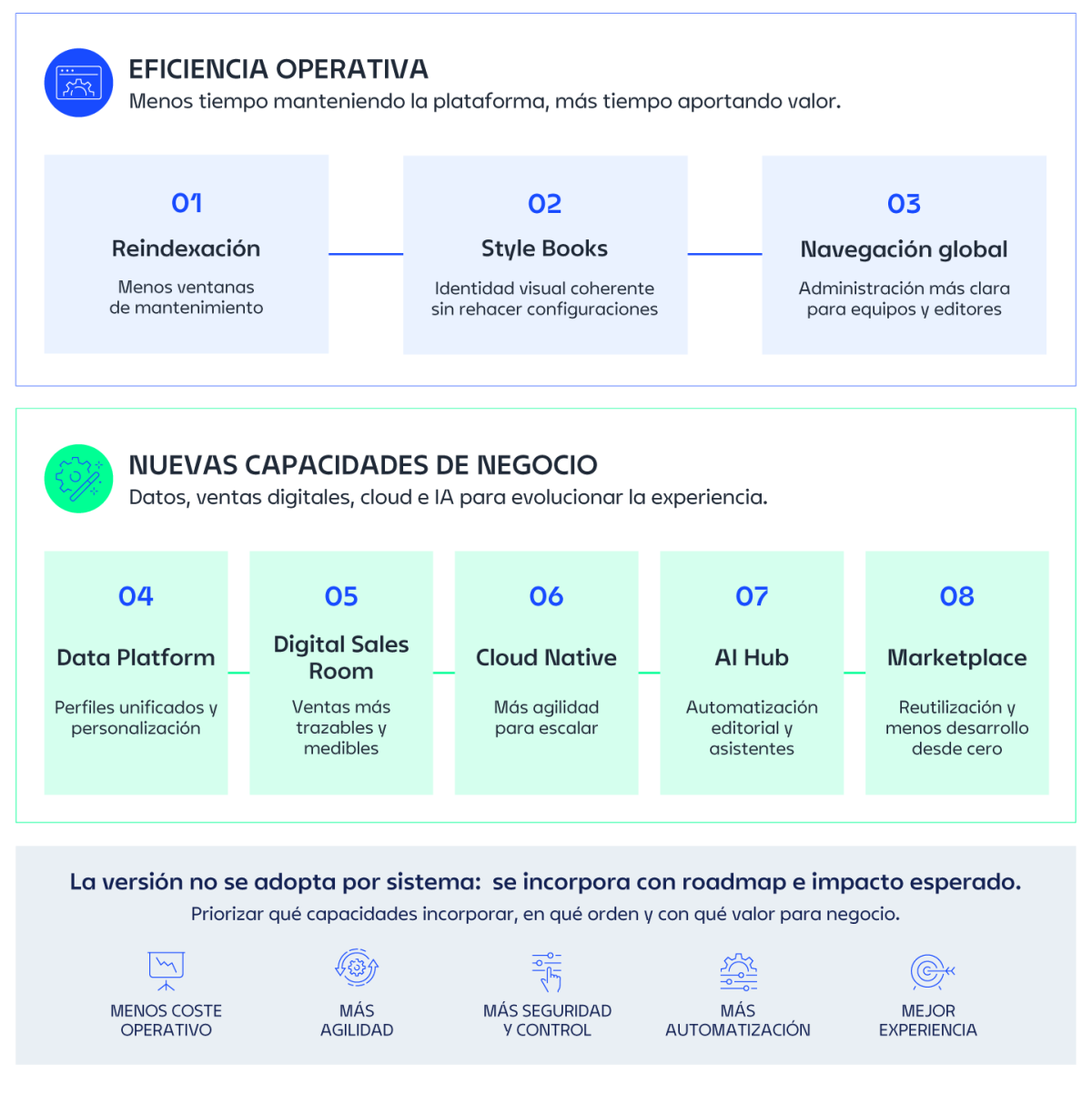
The real business impact lies not in updating for the sake of updating, but in having a clear technological roadmap that takes into account support, security, integrations, customizations, deployment model, and functional evolution.
Liferay maintains its quarterly release model, in which Q1 versions act as LTS versions, with long-term support, while Q2, Q3, and Q4 versions allow for more frequent updates. In this context, Liferay DXP 2026 Q1 is the current LTS version, with premium support until March 2029, while Liferay DXP 2026 Q2 is supported until May 13, 2027.
This model allows each organization to make more informed decisions. Some will prioritize stability and extended support. Others will prefer to adopt new capabilities sooner that can provide functional, operational, or commercial value.
When this planning is lacking, updates become an urgent matter. When they are implemented systematically, they become a lever for evolving the platform.
Less time operating the platform. More time adding value.
Several of these updates have a common goal: to reduce the effort that teams dedicate to operating, maintaining, and managing the platform.
One of the most significant improvements affects reindexing processes. Liferay has optimized the indexing architecture, achieving time reductions of at least half in certain scenarios and performance improvements of up to ten times in some workloads.
This improvement is especially important in environments with intensive use of Liferay Objects, large volumes of data, or complex models. Less time spent rebuilding indexes means less operational friction, fewer maintenance windows, and greater capacity to evolve the platform without compromising availability.
Greater agility to maintain visual consistency: Style Books
Improvements are being introduced to Style Books, making it easier to create new visual variations from an existing Style Book or theme.
The new feature is that it's now easier to reuse predefined colors and maintain their relationship to the original definitions. This avoids repetitive manual configurations and allows changes to be applied more consistently across Style Books that rely on a common base.
For organizations with extensive portal ecosystems, this improvement makes it easier to create new sites, manage different brands or areas, and maintain a consistent visual identity.
Furthermore, it reduces manual configurations and gives more autonomy to management teams, without losing the visual governance defined by the organization.
New global navigation: clearer and more organized management
Another new feature is the evolution of global navigation, the interface from which administrators, technical teams and editor profiles access the main management areas of the platform.
The change primarily affects how you access Applications, Commerce, Control Panel, CMS (when enabled), and the site list. In previous versions, these areas were organized within the Global Menu using tabs. Starting with Liferay DXP 2026 Q2, each of these options opens a separate page, with functionalities grouped on the left side, a search bar, and more comprehensive visual access points in the center.
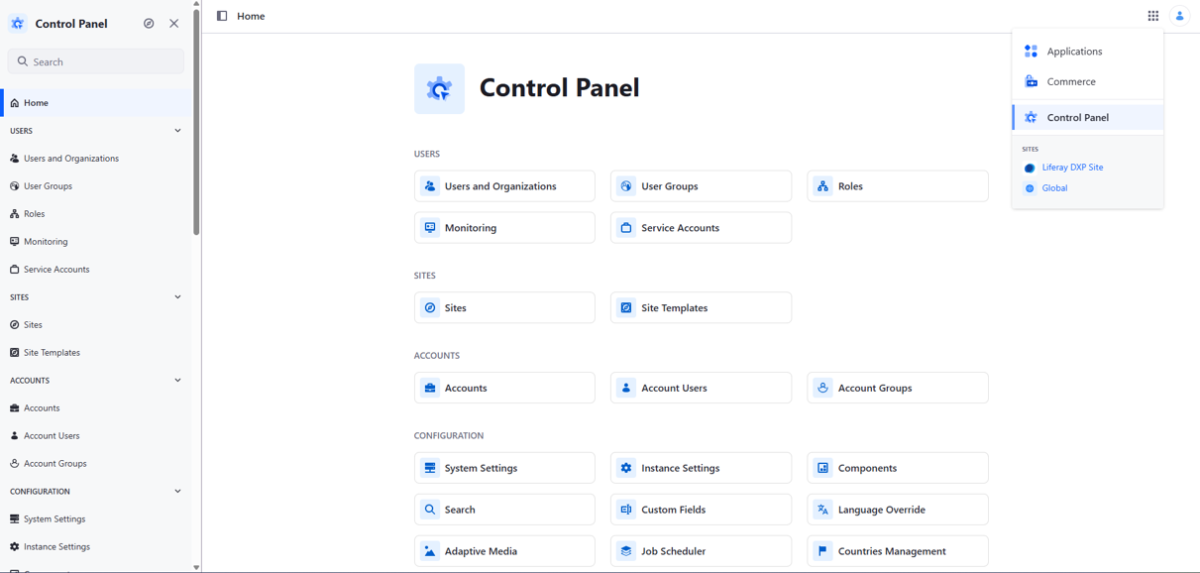
Although it may seem like a significant change visually, especially for customers accustomed to the previous navigation over the years, the learning curve is short. The functional logic remains the same: users still access the same administrative areas, but with a clearer, more organized, and more user-friendly layout.
This change significantly improves the daily experience in environments with many sites, multiple modules, different editorial teams, or platforms that make intensive use of Liferay capabilities. Everything is better structured, and it's easier to locate available features.
You can see the details of the new navigation model at this link.
From data to business-generating experiences
One of the most relevant new features of this version is Liferay Data Platform, an evolution of Analytics Cloud with Customer Data Platform capabilities.
Its objective is to consolidate information from different sources, such as CRM, commercial platforms or marketing tools, to build unified customer and account profiles.
The value lies not only in having more data, but in being able to use it to enable more personalized experiences within Liferay DXP. This opens up clear possibilities in B2B portals, private customer areas, sales experiences, segmentation, recommendation, and marketing automation.
For organizations with complex relationship models, multiple stakeholders, or long business cycles, this capability allows bringing the digital experience closer to real customer knowledge.
New experiences for complex sales
In line with making the customer relationship more measurable, Liferay introduces Digital Sales Room, a new offering aimed at creating sales microsites associated with business opportunities.
A digital salesroom allows you to share proposals, documents, resources, and materials in a controlled branded environment, with secure access for sellers and buyers.
Its main contribution is that it allows you to know what content generates interest, who accesses it, and how the different participants interact during the sales process.
In long sales cycles, with several stakeholders and a lot of documentation, Digital Sales Room replaces the scattered exchange of emails with a more traceable, organized and measurable experience.
Furthermore, it expands the role of Liferay beyond the traditional corporate portal, taking it to scenarios of business relationships, collaboration with accounts, and digital support during complex sales processes.

A cloud-based foundation ready to scale
In the cloud sector, one of the most notable new features is the general availability of AWS Ready Cloud Native.
This capability is part of Cloud Native Experience, Liferay's suite of tools designed to quickly and reliably provision the infrastructure needed to deploy and operate Liferay DXP in cloud environments.
Cloud Native AWS Ready allows you to deploy Liferay DXP on AWS with a foundation prepared to operate the platform in that environment. Furthermore, Liferay is working on variants for GCP and Kubernetes as the next steps, and plans to support Azure in the future.
For organizations, this means less friction when moving towards cloud-native architectures, automating infrastructure, scaling environments, and adapting the deployment model to their actual needs.
Not all organizations need the same infrastructure model, but increasingly they need platforms prepared to operate with greater agility, control and evolutionary capacity.
AI connected to digital content and processes
AI Hub is one of the most significant evolutionary paths in the Liferay ecosystem. In this version, it moves from private beta to public beta, making it easier for more customers and partners to begin validating real-world AI use cases connected to Liferay.
One of the most interesting aspects is that AI Hub is offered as a SaaS product, but it can connect with different Liferay DXP models: self-hosted, PaaS, or SaaS environments. This allows for the integration of AI capabilities without necessarily requiring a change to the current deployment model.
Its initial use cases are especially focused on content management and task execution through agents: editorial generation and review, translation, content classification, summaries, and chatbots or search engines based on the organization's own knowledge using RAG approaches.
The value lies not in using AI in isolation, but in integrating it with the content, processes, and channels that already exist in Liferay.
In addition, the roadmap includes various model providers, MCP servers, and customer-managed models, which is especially relevant for organizations with security, privacy, data governance, or technological sovereignty requirements.
In practical terms, AI Hub can help accelerate content production, improve editorial quality, reduce manual tasks, facilitate multilingual management, and create digital assistants more aligned with the real information of each organization.
Marketplace: an ecosystem that avoids reinventing the wheel
The Liferay Marketplace continues to grow and gain prominence as a way to expand the platform's capabilities. This version incorporates new applications, snippets, and components geared toward different use cases: migrating legacy developments to Liferay Objects, AI-powered image classification, dashboards, automation, commerce, advanced analytics, and generating summaries and responses about content.
Each new capability available in the Marketplace can mean less development from scratch, shorter implementation time, and greater speed in addressing common needs.
Final considerations for a technology roadmap
No single version offers the same benefits to every organization. A company that needs to stabilize its current platform is not the same as one that wants to migrate from older versions, move towards cloud-native models, incorporate AI into its editorial processes, or evolve its digital experience.
That's why we recommend evaluating each case according to the current version, support, integrations, deployment model, existing customizations, and functional roadmap, before adopting new features system by system.
Liferay DXP 2026 Q2 confirms a clear direction: a more modular, data-driven platform, better prepared for cloud-native environments, and increasingly connected to artificial intelligence. For those already working with Liferay, or considering doing so, this is a good time to review their technology roadmap and decide which capabilities to incorporate, in what order, and with what expected impact.
At ALTIA we can help you assess what this new version means for your Liferay platform, define an upgrade or evolution roadmap, and identify which capabilities can bring real value to your organization.


