The acceleration of digitalization has led organizations to deploy multiple channels to connect with their team, customers, the public, suppliers, and other stakeholders. Corporate websites, intranets, customer portals, online stores, and electronic headquarters have emerged to address specific business needs at different stages of their evolution.
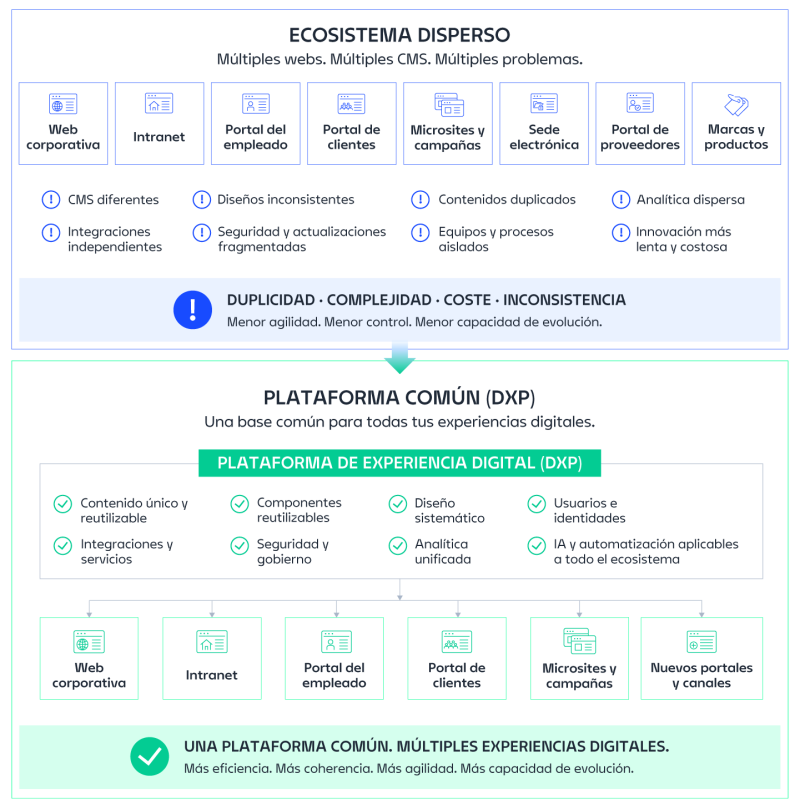
Over time, many of these platforms have evolved independently, incorporating their own technologies, content management systems, integrations, and operating models. This reality creates fragmented environments that hinder governance, increase technological complexity, and limit the ability to manage the digital ecosystem in a coordinated manner.
As a result, organizations face higher operating costs, redundancies, and difficulties in delivering consistent and scalable experiences. In this context, the challenge is no longer just about developing new portals or applications, but about defining a strategy that allows for the efficient governance, optimization, and evolution of the organization's entire suite of digital experiences.
The need for a unified vision
Given this fragmentation, the challenge is to move from managing individual platforms to governing, optimizing, and evolving the entire digital ecosystem in a coordinated manner.
The true impact of a dispersed digital ecosystem
When organizations analyze the cost of their digital platforms, they usually focus on visible elements such as licenses, infrastructure, or maintenance.
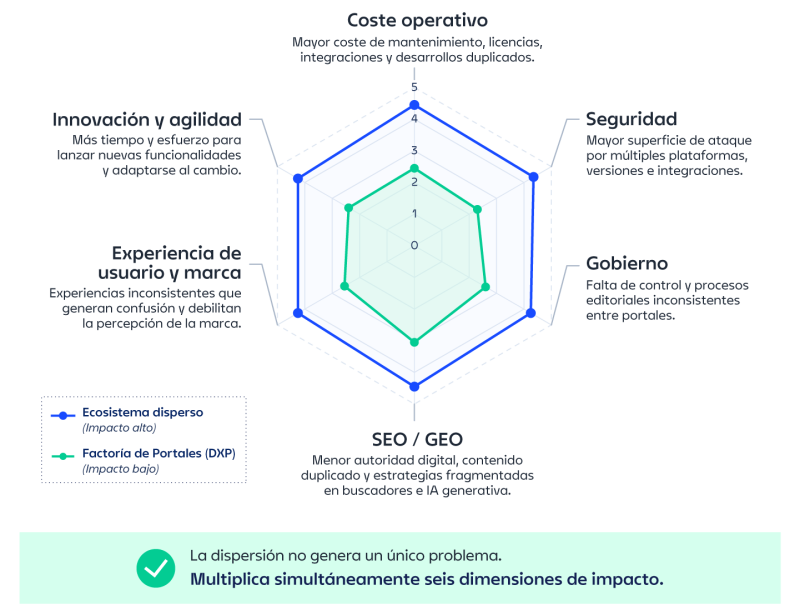
However, a significant portion of the investment is focused on the ongoing evolution of these environments: maintaining integrations, managing security, updating technologies, and incorporating new capabilities. When multiple independent platforms exist, these efforts multiply.
The impact of this fragmentation extends beyond the economic sphere. The need to replicate changes and developments across different environments slows down business responsiveness and limits the adoption of strategic initiatives. Furthermore, it directly affects key aspects such as security, content governance, user experience, digital positioning, and innovation, creating a challenge that must be analyzed from multiple interrelated dimensions.
The portal factory as a response
When the challenge affects the entire digital ecosystem, the solution cannot be approached portal by portal. The portal factory proposes a change of focus: evolving from the management of independent digital experiences towards a model based on a common platform, with shared architecture, components, content, integrations, and governance.
Digital experience platforms (DXPs) allow you to centralize and reuse these capabilities across multiple portals, while maintaining the identity and specific needs of each brand, business area, or service. The goal is not to homogenize all experiences, but to share what delivers efficiency and differentiate what generates value.
This model allows us to accelerate the launch and evolution of new portals, reduce duplicate efforts, strengthen security and accessibility, improve SEO/GEO strategy, and more easily incorporate capabilities such as artificial intelligence and personalization. Ultimately, we are not looking to reduce the number of digital experiences, but rather to ensure they all evolve in a coordinated manner under a single digital strategy.
Evolving towards a common digital ecosystem
The goal is not to create new channels, but to ensure that all existing channels evolve coherently, securely, and sustainably. The portal factory enables the transition from independent projects to a shared digital ecosystem, facilitating the sharing of content, components, integrations, and capabilities to reduce duplication and accelerate evolution.
The goal is not to homogenize experiences, but to have a common base that preserves the identity of each brand or service.
Because the challenge is no longer to build a new website, it's to make the entire digital ecosystem work and evolve as a single platform.