
Salesforce is much more than a CRM: it has become a complete business platform, designed to connect data, processes, people and artificial intelligence around a key concept: Customer 360.
Salesforce: from CRM to business platform
Salesforce has evolved from a traditional CRM to a unified cloud platform, capable of covering end-to-end processes related to customers, citizens, patients, students, partners, or employees.
It's not about adding modules, but about building a common base where data is unified and governed, processes are automated across the board, artificial intelligence acts on the real business context, and applications share a single, real-time view.
This approach eliminates silos, accelerates decision-making, and allows for progressive scaling of digitization.
Customer 360: the heart of the ecosystem
The Customer 360 concept is the central focus of Salesforce. It consists of having a single, consistent view of each entity (customer, citizen, student, patient, etc.), integrating:
- Historical and real-time data
- Interactions across all channels
- Sales, service, marketing, and operations processes
- AI-generated results, predictions, and recommendations
At ALTIA, we don't implement Customer 360 like a "big bang". We always start with a maturity assessment, prioritizing the processes with the greatest impact and defining an evolutionary roadmap, focused on measurable results from the earliest stages.
The major layers of the Salesforce ecosystem
To understand Salesforce, we can visualize it as a layered architecture, where each level provides specific value and relies on the previous one.
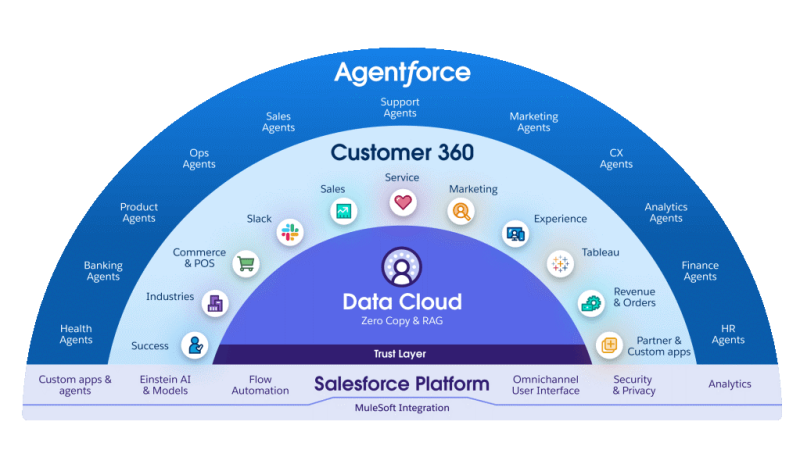
Salesforce Platform: the technological foundation
It is the secure and extensible cloud infrastructure upon which the entire ecosystem is built. This foundation reduces implementation times, facilitates adaptation to real-world processes, and avoids isolated developments.
- Security, compliance and governance (Trust Layer)
- Low-Code / No-Code Automation (Flow, OmniStudio)
- Custom application development
- Integration with external systems
At ALTIA we connect Salesforce with the rest of the client's IT ecosystem (ERP, legacy systems and industry solutions), with experience in complex environments such as public administration, education, banking, industry or healthcare.
Data Cloud: unified data and real-time intelligence
Data Cloud acts as the data and intelligence layer of the Salesforce ecosystem:
- Unify data from multiple sources (CRM, ERP, web, IoT, industry systems…)
- It resolves identities and creates a single source of truth
- It allows real-time activation without duplicating data (Zero Copy)
- It directly powers business processes and artificial intelligence
The ROI is widely demonstrated: economic impact studies reflect returns exceeding 300% in three years in data integration and activation scenarios.
Customer 360 Apps: Connected business applications
The functional clouds are structured on that basis:
- Sales: sales, pipeline and forecasts
- Service: omnichannel and self-service support
- Marketing: segmentation, journeys and personalization
- Experience: customer, partner, or citizen portals
- Commerce, Revenue, Tableau, Slack ...
They all share data, processes, and intelligence, enabling consistent, traceable, and scalable experiences. It's no coincidence that Salesforce is consistently recognized as a leader by independent analysts in areas such as sales automation, low-code platforms, and digital marketing.
In the Sales Force Automation (SFA) field, Salesforce appears as a leader in the Gartner Magic Quadrant 2024 for the eighteenth consecutive time, standing out in Ability to execute and Complete vision.
Agentforce: the new layer of intelligent automation
Agentforce represents the natural evolution of the ecosystem: intelligent agents based on generative AI that not only analyze, but also act.
- Sales agents who prioritize opportunities and generate proposals
- Support agents that automatically resolve incidents
- Analytical agents that summarize information and suggest actions
- Sector-specific agents with pre-configured business logic
The impact on productivity is clear: organizations that adopt AI applied to CRM processes report productivity increases of up to 30%.


